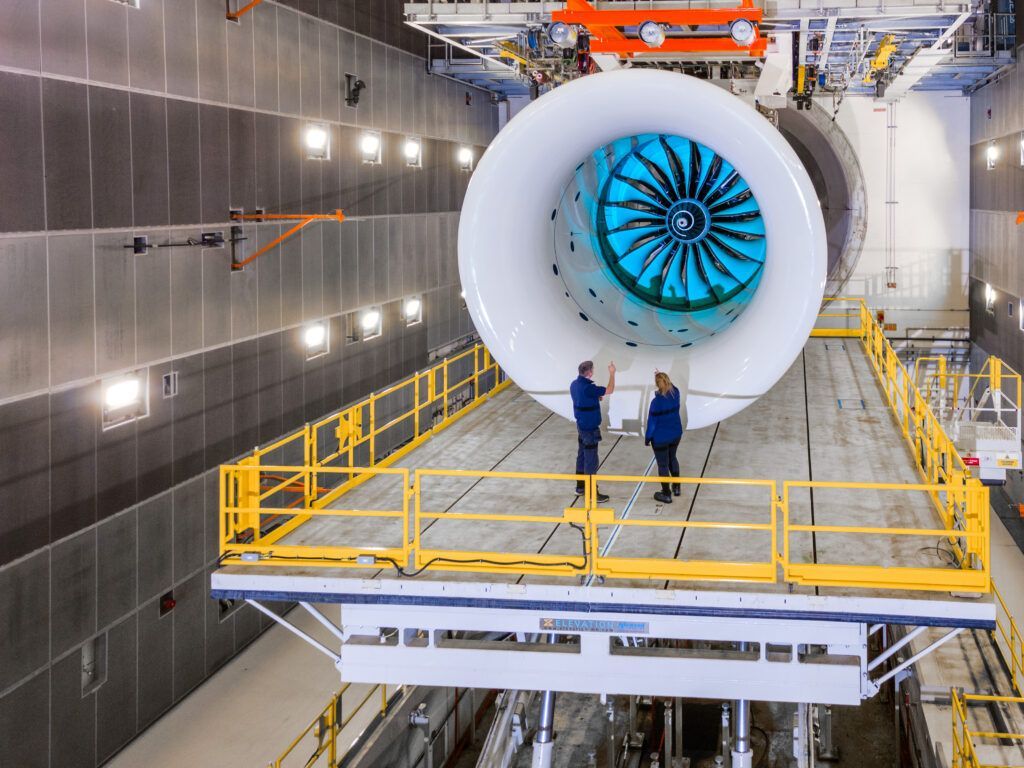


THE SME ADVANCED MANUFACTURING PLAYBOOK

An analysis for aerospace supply chain businesses in the South East, examining the current landscape, the pivotal contract decisions, and the technological shifts defining the road to 2026.
For the last five years, the aerospace sector has been buzzing with terms like "Industry 4.0," "Digital Transformation," and "AI-driven factories." But if we are honest, much of that was experimental—pilot programs, proof-of-concepts, and isolated pockets of innovation.
Welcome to 2026. This is the year the experiments end and the real work begins.
As we settle into the new year, the landscape of advanced manufacturing is shifting from adoption to scaling. The "Factory of the Future" is no longer a slide in a pitch deck; it is becoming the operational standard. Here is your look at the four critical developments defining aerospace manufacturing in 2026, backed by the data we are seeing on the ground.
1. AI Goes "Agentic": From Analysis to Action
In 2024 and 2025, Artificial Intelligence in manufacturing was largely passive. It was a dashboard that told you, "Hey, this machine is vibrating abnormally," or "Supply chain disruption likely in 3 weeks." It was helpful, but it still required a human to decide what to do next.
In 2026, we are seeing the rise of Agentic AI. These are AI systems capable of autonomous planning and execution. Instead of just flagging a maintenance issue, 2026-era systems can:
- Schedule the downtime during a low-production window.
- Order the replacement part from the digital inventory.
- Re-route production to a different line to minimize yield loss.
This shift allows human engineers to move away from "putting out fires" to focusing on complex problem-solving.
The Evidence: This isn't just theory. The TCS "Future-Ready Skies" study released late last year revealed that nearly two-thirds of aerospace executives now expect Agentic AI to deliver measurable ROI in supply chain operations by this year. Furthermore, with Capgemini's 2025 report noting that 14% of organizations had already scaled AI agents, we are now seeing these systems actively managing predictive maintenance workflows in Tier 1 supplier facilities without human intervention.
2. Additive Manufacturing: Graduation Day
For a decade, 3D printing (Additive Manufacturing or AM) in aerospace was synonymous with "prototyping" or "complex, low-volume brackets."
This year, AM is graduating to mass production. With supply chain resilience becoming a national security priority, major OEMs have finalized the shift to "Digital Warehouses." Instead of shipping titanium spares halfway across the world, parts are being printed on-demand at maintenance hubs closer to the point of need.
Key 2026 shifts include:
- Multi-Laser Systems: Faster print speeds are finally making the business case for AM viable for mid-sized production runs.
- Certification Maturity: The regulatory friction is easing as standard qualification pathways become codified.
The Evidence: Airbus ended 2025 with a major milestone, confirming they are now producing over 25,000 flight-ready 3D-printed parts annually, including critical components for the A350 that achieved a 43% weight reduction. Similarly, Boeing's acquisition of Spirit AeroSystems last year was a strategic move to vertically integrate these advanced manufacturing capabilities, ensuring that digital inventory systems meet strict quality controls across the board.
3. Digital Twins Get a "Brain"
We all know what a Digital Twin is—a virtual replica of a physical asset. But until recently, most twins were static. They were great for looking at historical data, but they couldn't think.
The 2026 generation of Digital Twins are intelligent systems. By integrating real-time sensor data with the Agentic AI mentioned above, these twins can run thousands of simulations per minute to predict future outcomes.
Imagine a wing assembly line where the Digital Twin notices a micro-tolerance drift in the robotic drilling process. It doesn't just record the error; it simulates the impact of that drift on the final aerodynamic performance and creates a "correction script" for the robot in real-time.
The Evidence: Look at the Saint-Eloi plant, where real-time data integration is now detecting quality deviations before they occur. Major players like Siemens and NVIDIA have pushed their industrial metaverse platforms to the point where "lights-out" manufacturing (fully automated) is projected to reach 40% of operations within the next 5 years, according to recent analyst data.
4. Sustainability as a Design Constraint
Sustainability is no longer a "Nice-to-Have" slide in the annual report; it is a hard manufacturing constraint.
With stricter regulations on carbon tracking coming into full force this year, the "Green Thread" is being woven into the manufacturing process itself. We are seeing:
- Circular Manufacturing: Increased use of recycled aerospace-grade composites.
- Energy-Aware Scheduling: Factories that automatically throttle high-energy processes (like autoclaves) to run during hours when renewable energy availability on the grid is highest.
The Evidence: The ReFuelEU Aviation Regulation mandates that kicked in recently (requiring 2% SAF usage) have created a ripple effect upstream. Manufacturers are now under immense pressure to cut Scope 1 & 2 emissions to offset operational costs. This has driven the adoption of "Circular Design" principles, as seen in the Cabin Vision 2035 initiative, which prioritizes recyclable materials for interior components to meet new EU waste standards.
The Bottom Line
If 2025 was the year of "stabilization" after the post-pandemic chaos, 2026 is the year of integration. The silos between design, supply chain, and the factory floor are dissolving. The winners this year won't just be the ones with the best technology, but the ones who successfully integrate that technology into a cohesive, autonomous ecosystem.
Key Takeaways for 2026
- AI is acting, not just analyzing. (Supported by TCS & Capgemini data)
- 3D Printing is for production. (Evidenced by Airbus's 25k parts/year milestone)
- Digital Twins are decision makers. (Validated by Saint-Eloi & Siemens implementations)
- Green manufacturing is non-negotiable. (Driven by ReFuelEU & Circular Design mandates)
The Impact of Tariffs - A 2026 Geopolitical Outlook:
Manufacturing Through the "Tariff Wall"
As of January 2026 the geopolitical landscape for aerospace manufacturing has fundamentally hardened. The "Global Village" supply chain we spent 20 years building is being partitioned by walls—specifically, tariff walls.
With the Universal Import Tariff (10%) now fully operational across US ports, and targeted duties on titanium and high-grade alloys hitting 50% for non-allied nations, the cost structure of aerospace manufacturing is under siege.
But here is the counter-intuitive truth: Advanced manufacturing is your best hedge against a trade war.
Here is how some players are using technology to navigate the geopolitical minefield of 2026.
1. The "Tariff-Busting" Power of Additive Manufacturing - In 2025, we talked about 3D printing for speed. In 2026, we talk about it for duty avoidance.
Traditional manufacturing relies on shipping physical parts across borders, each crossing incurring a tariff event.
- Old Way: Ship a titanium bracket from a Tier 2 supplier in Asia to the UK for finishing, then to the US for assembly. Result: Multiple tariff hits.
- New Way (2026): Send a secure digital file to a printer located inside the US border (or a tariff-free zone).
The Strategy: "Digital Inventory" isn't just about saving warehouse space anymore; it’s about Import Substitution. By printing the part inside the tariff wall, you bypass the import duty entirely. We are seeing UK firms lease capacity in US-based "Print Farms" to fulfill contracts without technically "exporting" a physical good that triggers a 10% levy.
2. Radical Material Efficiency (Buy Less, Pay Less) - With raw material tariffs spiking the price of aerospace-grade aluminum and titanium by roughly 35% since last year, waste is no longer just "inefficient"—it is ruinous.
Traditional "Subtractive Manufacturing" (CNC machining) often turns 90% of a raw metal billet into scrap chips (the "Buy-to-Fly" ratio).
- The Shift: Manufacturers are aggressively adopting Near-Net Shape manufacturing (using forging or additive methods to create a part very close to its final size).
- The Impact: If you reduce your raw material buy by 50%, you effectively neutralize the tariff hike. The winners in 2026 are the shops that can demonstrate the lowest buy-to-fly ratios to their customers.
3. Supply Chain "Friend-Shoring" - Geopolitics has split the world into "Trusted" and "High-Risk" zones. The US-UK "0% for 0%" deal on aerospace engines and parts (active as of June 2025) has given UK manufacturers a massive tactical advantage over EU competitors, who may still face friction.
However, "Friend-Shoring" requires proof.
- The Tech: Blockchain-backed Digital Passports.
- The Application: It is no longer enough to say, "We made this in Derby." You must prove the titanium sponge didn't originate from a sanctioned entity. Advanced ERP systems are now integrating "Geopolitical Risk Scoring," automatically blocking suppliers who cannot digitally verify the origin of their raw materials.
The UK Advantage: How to Play Your Hand
The UK finds itself in a "Goldilocks" zone in 2026—historically close to the US defense industrial base but independent enough to be agile.
Action Plan for UK Advanced Manufacturers:
1. Audit Your "Melt and Pour" Source
The US is strictly enforcing "Melt and Pour" requirements for steel and aluminum exemptions.
- Action: Do not rely on paper certificates. Implement a digital material tracking system (Digital Twin of the supply chain). If you can prove your alloy was melted in Sheffield, not Shanghai, your product is effectively 10-25% cheaper to a US buyer than a competitor's.
2. Pitch "Tariff-Free Innovation"
- Action: When bidding for US work, explicitly highlight the US-UK 0% tariff agreement on aerospace parts.
- The Pitch: Remind US procurement officers that buying from you is administratively simpler than buying from the EU or Asia. Use your "Total Landed Cost" (which includes avoided tariffs) as your primary sales metric, not just ex-works price.
3. Invest in "Sovereign" AI
Data sovereignty is the new battleground. The US is increasingly wary of software tools that route data through non-allied servers.
- Action: Ensure your AI and Digital Twin infrastructure is hosted on "Sovereign Cloud" solutions (UK or US-based servers). Being "ITAR Compliant" (International Traffic in Arms Regulations) is now a baseline requirement even for commercial aerospace suppliers looking to enter the US defense ecosystem.
Summary
The trade wars of 2026 are not fighting against globalization; they are re-wiring it. The flows of goods are moving away from "Lowest Price" to "Highest Trust."
Advanced manufacturing—through 3D printing, material efficiency, and digital traceability—is the only way to remain competitive in a world where a 10% tariff can wipe out your margin overnight.